
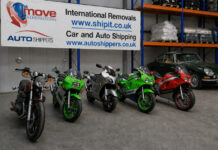


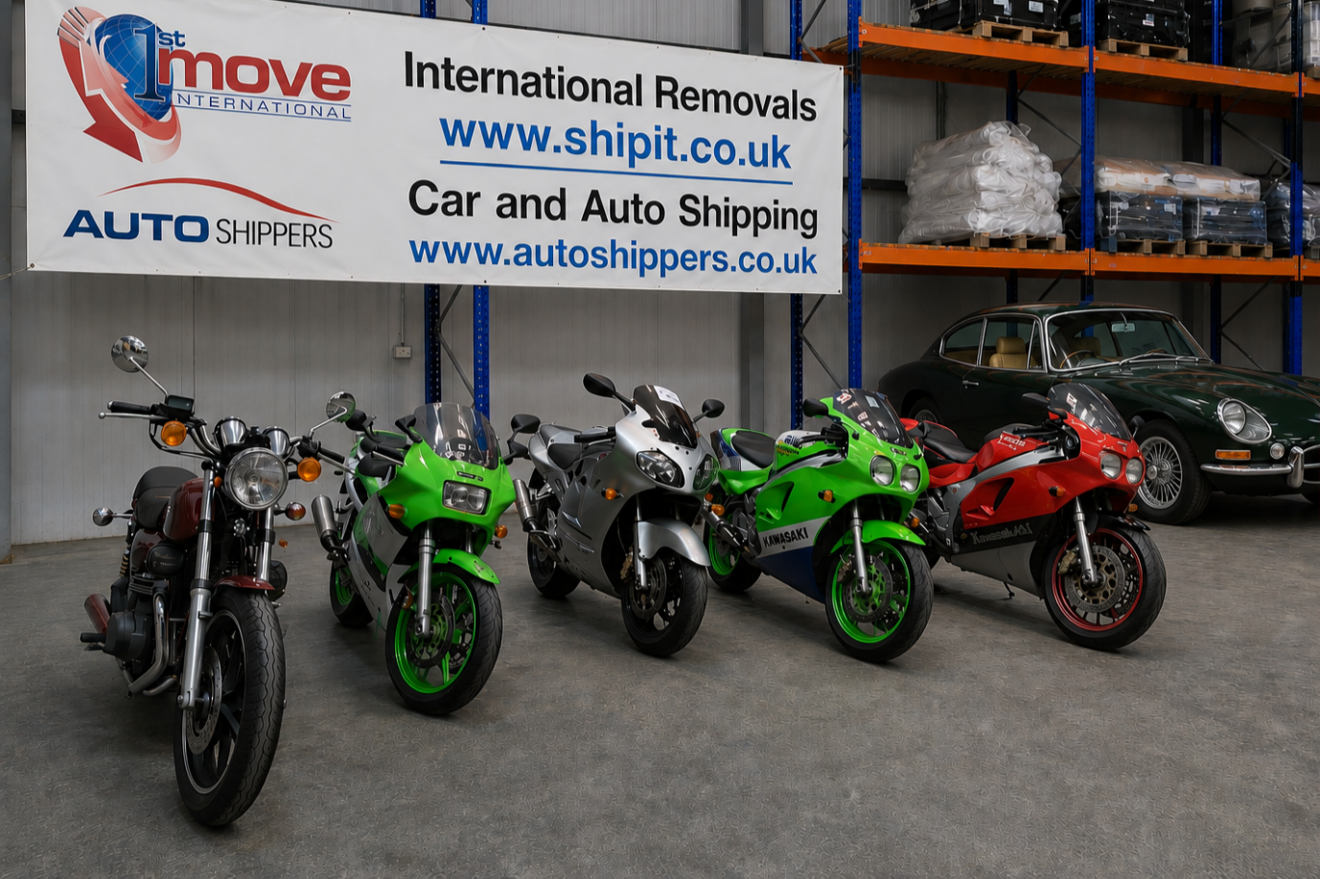
Justin was heading home to the USA after several years stationed there with the US military, and he wasn’t about to leave his Kawasaki collection behind. Five bikes, spanning more than two decades of the brand’s history, were ready to make the journey with him now, with more of the collection to follow in time.
It wasn’t as simple as booking a container and loading them in. Each bike had to be checked against US import rules, some were ready to travel now and some weren’t, and every one of them needed protecting for a journey that would take it halfway around the world.
The Motorbikes in This Collection Shipped to the USA
The collection spanned more than two decades of Kawasaki history:
- Kawasaki KZ650 (1978). A historic, air-cooled classic and the oldest bike in the shipment.
- Kawasaki KR-1 (1990). A rare two-stroke model, firmly in collector territory.
- Kawasaki ZX-7R (1989, red). An early-generation ZX-7R, representing Kawasaki’s late-80s performance era.
- Kawasaki ZX-7R (manufactured 1989, green). Registered later in the UK, but manufactured early enough to qualify for US import.
- Kawasaki ZX-12R (2000). A flagship hyperbike of its time, shipped as soon as it became eligible under the 25-year rule.
All five bikes were fully running, well maintained, and part of a collection Justin had built up over many years.
Shipping a Motorbike Collection
Not every bike in Justin’s collection was ready to travel. US import rules go by date of manufacture rather than UK registration date, so while some of his bikes had already cleared the 25-year threshold, others hadn’t yet.
Rather than risk a refusal at port, the collection was split. The eligible bikes travelled now, and the rest will follow once their time comes.
Choosing LCL Shipping for Multiple Motorbikes
Rather than book a sole-use container, the collection was shipped using LCL, Less than Container Load, shipping. LCL suits a shipment like this well: it doesn’t need an entire container to itself, but each bike still needs to be prepared and protected individually.
Justin’s bikes were crated separately, then consolidated with other freight bound for the same destination. That kept costs sensible without compromising on protection, though it does raise the stakes on the crating itself, since the shipment passes through more handling stages than a dedicated container would.
Once prepared, the bikes were collected and taken to the export facility, loaded as part of the wider consolidated shipment, and the container was sealed for ocean transport to the USA.
Bespoke Motorbike Crating for International Shipping
Each Kawasaki motorbike was placed into its own made-to-measure wooden crate, built specifically for that bike’s dimensions, weight, and profile. This was a bespoke crating solution rather than a standard bike box, and that distinction is important when shipping valuable motorbikes overseas.
That individual approach mattered here. The KZ650, an upright, air-cooled classic with high bars and an exposed engine, needed straps and support points suited to its simple, naked frame. The later sports bikes in the shipment, with full fairings, low-slung riding positions, and a completely different centre of gravity, needed their strapping and structural support planned around a very different shape entirely. Treating every crate as a one-off build, rather than working from a single template, is what made it possible to protect such a mixed collection properly.
Before crating, each bike had to be carefully assessed and positioned so it could be secured safely for transit. The aim was to keep the motorbike stable, immobilised, and protected from the moment it left the UK until it arrived in the USA. Any loose items, vulnerable components, or protruding parts needed to be accounted for before the crate was sealed.
Each crate was designed to do several jobs at once. It needed to prevent movement during handling and consolidation, support the bike at structurally appropriate points, protect bodywork and paintwork, and allow safe forklift and port handling without relying on straps alone. That is particularly important for motorbikes travelling by sea, where freight may be moved multiple times before the final delivery point.
Sensitive areas of the bikes were padded and protected, while each motorbike was secured so it could not shift inside the crate. The crate structure also helped distribute weight properly, which is especially useful for heavier machines or bikes with more delicate balance points.
For mixed-era motorbikes, bespoke crating offers a major advantage. Older bikes can have scarce replacement parts, while newer performance models may have bodywork or components that are more easily damaged in transit. In both cases, a crate built to the bike’s exact dimensions reduces the risk of movement and impact damage.
Bespoke crating is also essential when shipping through an LCL service. Because the freight is consolidated and deconsolidated at different stages, the crate has to protect the motorbike not just during the sea voyage, but also through warehouse handling, loading, unloading, and container stuffing. In practice, that means the crate is doing most of the protective work, not just acting as a container around the bike.
For this shipment, the crating process was one of the most important parts of the move. It ensured that each motorbike was prepared properly for export, protected throughout transit, and ready for safe arrival in the USA.
Shipping the Motorbikes
Once crated, the bikes were collected and taken to the export facility, where they were checked again to make sure everything was secure and ready for transit. From there, the crates were loaded into the container alongside the rest of the consolidated shipment, and the container was sealed and booked onto the Atlantic Star, a container vessel sailing from Liverpool to Newark.
During ocean freight, the container stays sealed for the crossing. For classic motorbikes, that stage is all about stability: each bike was already immobilised inside its crate, which kept movement to a minimum across the 12-day, port to port transit.
On arrival in Newark, the container was opened and the crates deconsolidated as part of the import process, clearing the way for customs and final delivery. Because the paperwork had already been prepared correctly and the bikes qualified under the 25-year rule, that stage went smoothly.
For Justin, that meant this wasn’t a simple freight booking. It was a structured move, planned around the bikes themselves, the shipping method, and the import requirements, exactly what motorbike shipping needs to work properly.
Importing Motorbikes into the USA Under the 25-Year Rule
Each of the five bikes shipped had passed the 25-year threshold by manufacture date, qualifying them for import into the USA without needing to meet modern EPA or DOT standards. That exemption is widely used for classic and collector vehicles, but it only works when eligibility is checked carefully and supported by the correct paperwork.
One of the most common mistakes with US vehicle imports is assuming that registration date is what matters. In reality, it is the manufacture date that determines whether a vehicle qualifies under the 25-year rule. That distinction matters, especially when a bike has been registered later in the UK but was built earlier, as was the case with the green ZX-7R in this shipment.
Another common issue is incomplete or inconsistent documentation. For a shipment like this, the paperwork needs to clearly show the bike’s age and support its eligibility for import. Any confusion over dates or model history can create delays or even cause problems at port.
It’s also important not to assume that “classic” automatically means exempt. The rules still need to be applied correctly, and each bike has to be assessed on its own merits. In this case, the documentation was in order, which allowed the shipment to move forward without complication.
For Justin, that meant the shipment could be planned properly rather than rushed. The bikes that were eligible moved now, while the rest of his collection remains in the UK until they reach the right age for import, a staged approach that’s often the safest and most practical way to move a collection internationally.
The Motorbikes Shipped in This Collection
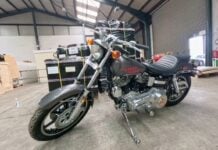
Spanning more than two decades of production, the five bikes below show how eligibility, condition, and careful crating come together when a mixed collection like this one is shipped internationally. Shown here partially crated, each motorbike was prepared and protected individually before beginning its journey from the UK to the USA.
Kawasaki KZ650 (1978)
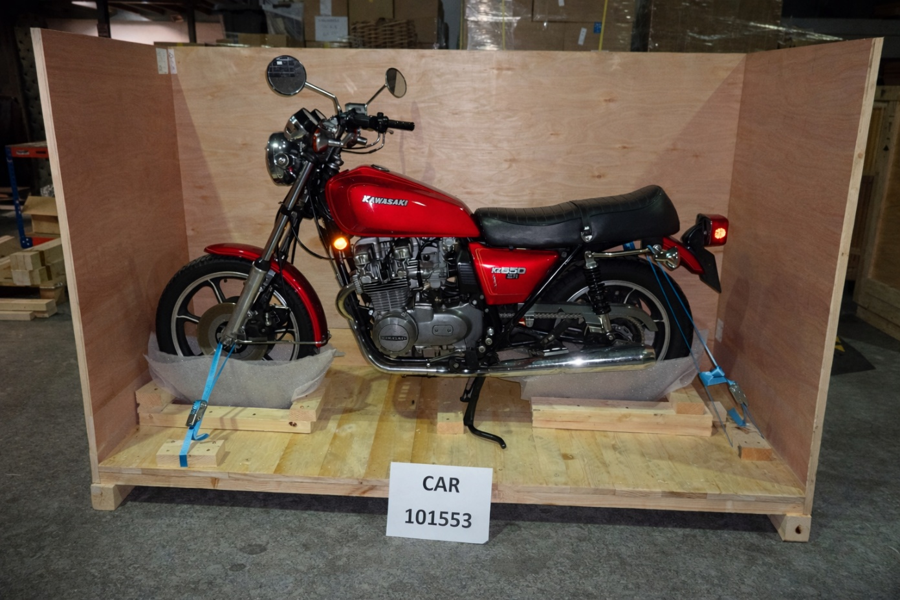
The Kawasaki KZ650 represents an important chapter in the brand’s late-1970s lineup, sitting neatly between the earlier Z-series bikes and the more performance-focused models that followed. With its air-cooled inline-four engine, upright riding position, and understated styling, it’s widely regarded as a usable classic rather than a museum piece.
As the oldest bike in the shipment, its manufacture date left no grey areas for US import eligibility. It was also the most distinctive shape in the collection, and its crate was built around that naked, high-barred frame rather than adapted from a template built for the newer bikes.
Despite its age, this KZ650 was fully running at the time of shipment, and was crated to protect original components and finishes that are increasingly difficult to source today.
Kawasaki KR-1 (KR250, 1990)
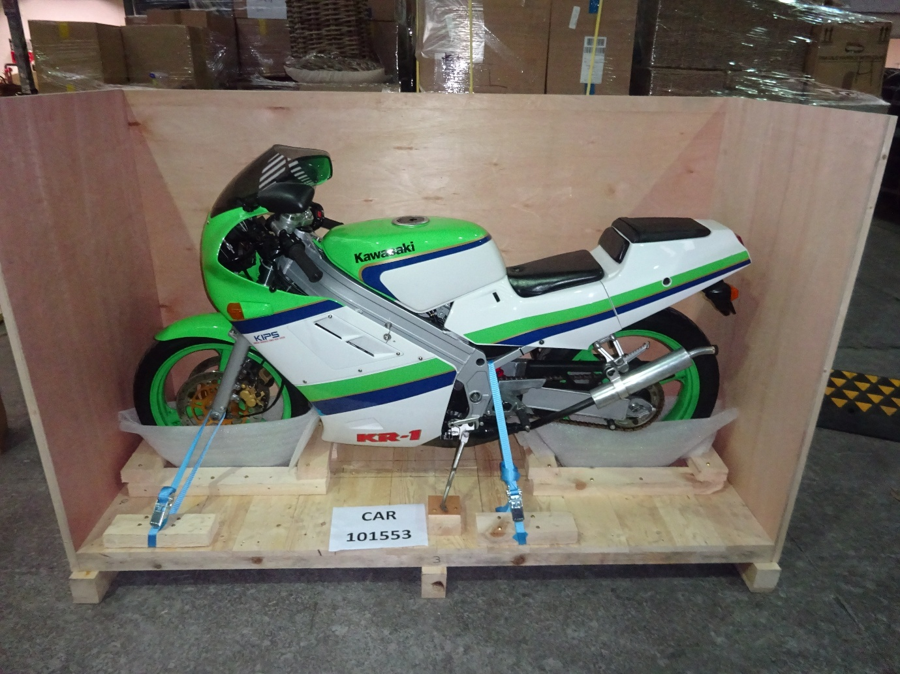
The KR-1 is one of Kawasaki’s most sought-after two-stroke road bikes, built during a short but influential production run in the late 1980s and early 1990s. Lightweight, sharp-handling, and unmistakably of its era, it has become a cornerstone model for collectors focused on Japanese performance bikes.
Two-stroke bikes bring their own crating considerations, with a different weight distribution and more delicate components than a typical four-stroke. Bespoke crating meant the KR-1 could be fully supported and held immobile for the whole journey, rather than fitted into a generic bike box.
Its manufacture date sat comfortably clear of the US 25-year threshold, making it a straightforward candidate for import as part of this shipment.
Kawasaki ZX-7R (1989 – Red)
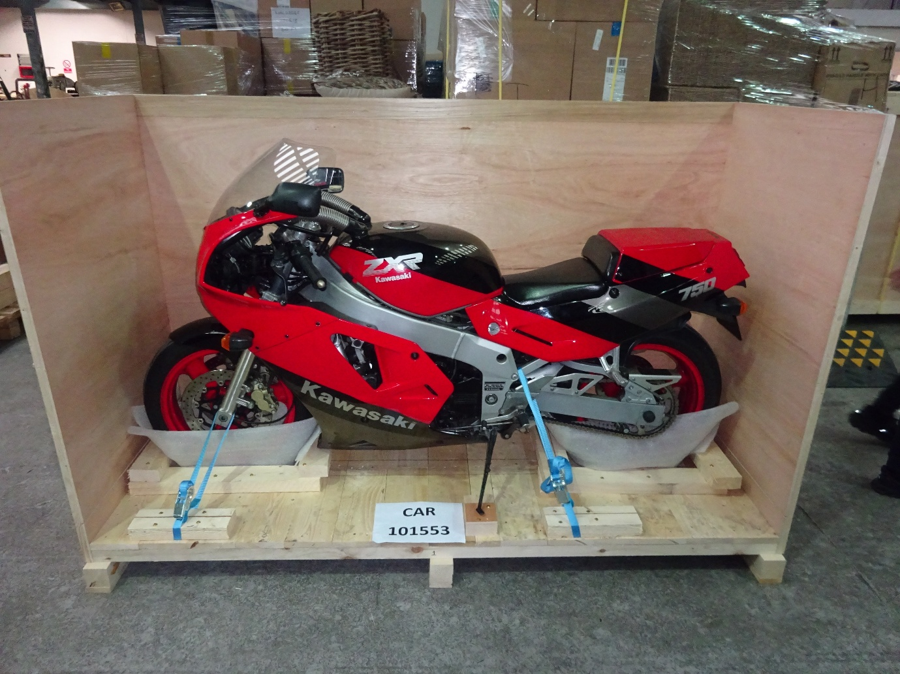
The early ZX-7R models mark Kawasaki’s transition into the modern superbike era. Produced at the end of the 1980s, these bikes combined race-inspired engineering with road-going usability, helping establish the ZX nameplate that followed for decades.
This red ZX-7R is from that earlier generation, and its manufacture date placed it well within US import eligibility. Performance-focused when new, examples like this are now valued as classic sports bikes rather than outright racers.
It was fully operational at the time of shipment and was crated individually to protect its bodywork, suspension, and frame geometry through the consolidated LCL journey.
Kawasaki ZX-7R (Manufactured 1989 – Green)
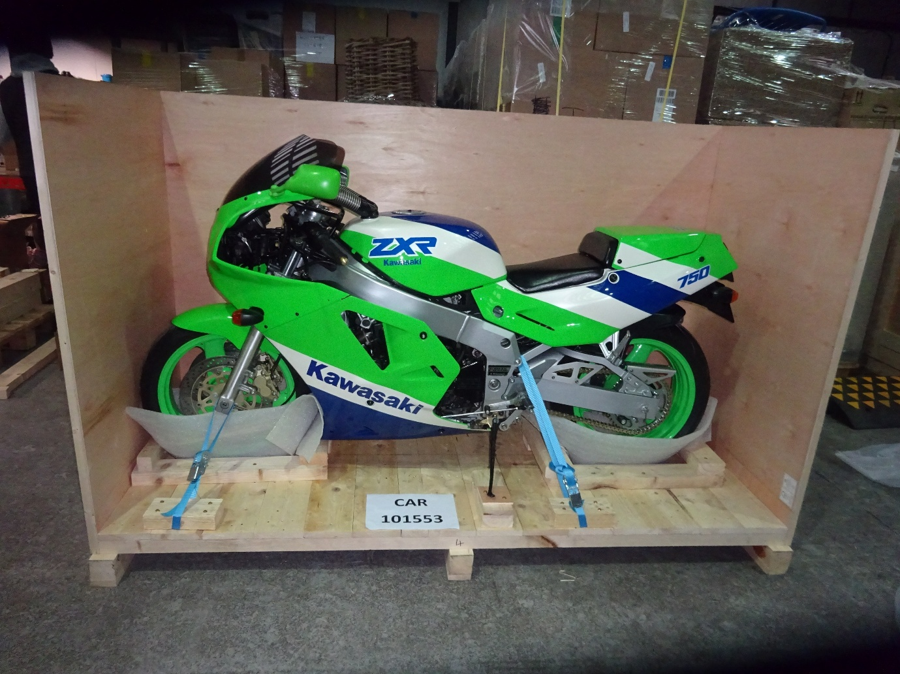
This ZX-7R carries a later UK registration than its sibling, but its 1989 manufacture date is what qualifies it for US import under the 25-year rule, the same distinction covered earlier in this piece.
From a collector’s perspective, later-registered examples like this often benefit from better original condition while still retaining classic eligibility, and it makes an interesting contrast to the earlier red ZX-7R shipped alongside it.
As with the rest of the collection, the bike was fully running and secured in a made-to-measure crate built around its exact dimensions.
Kawasaki ZX-12R (2000)
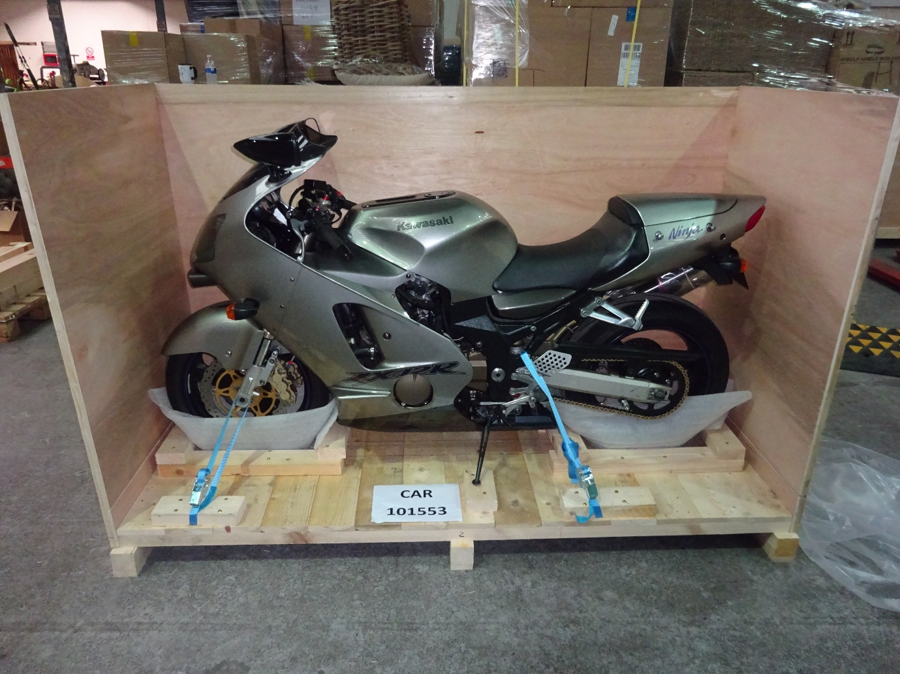
The ZX-12R was Kawasaki’s flagship hyperbike at the turn of the millennium, built to compete at the very top end of performance motorbikes. With its aggressive styling and large-capacity engine, it represents a different era of Kawasaki engineering compared to the earlier bikes in this shipment.
As the newest bike in the collection, it had only just cleared the 25-year threshold, and was shipped as soon as it became eligible. The rest of Justin’s collection, including bikes not yet old enough to qualify, will follow in the years ahead.
Given its size and weight, bespoke crating was particularly important, giving it the stability and support it needed through consolidation and the Atlantic crossing.
Shipping Classic Motorbikes from the UK to the USA
International motorbike shipping is about more than just transport. It’s about understanding the rules, choosing the right method, protecting each bike properly, and making sure the paperwork supports the move from the outset.
For Justin, bespoke crating, careful export handling, and LCL ocean freight brought five classic Kawasakis safely to the USA, with the rest of his collection to follow once the remaining bikes reach import age.
When classic or collector motorbikes are involved, getting the structure right early is what helps avoid delays later on, and it’s what let this shipment move as smoothly as it did, all the way from Liverpool to Newark.